Threshold energy

 In particle physics, the threshold energy for production of a particle is the minimum kinetic energy a pair of traveling particles must have when they collide. The threshold energy is always greater than or equal to the rest energy of the desired particle. In most cases, since momentum is also conserved, the threshold energy is significantly greater than the rest energy of the desired particle - and thus there will still be considerable kinetic energy in the final particles.

The threshold energy should not be confused with the threshold displacement energy, which is the minimum energy needed to permanently displace an atom in a crystal to produce a crystal defect in radiation material science.

ExampleEdit

Consider the collision of a mobile proton with a stationary proton so that a {\displaystyle {\pi }^{0}} meson is produced: {\displaystyle p^{+}+p^{+}\to p^{+}+p^{+}+\pi ^{0}}

Transforming into the ZMF (Zero Momentum Frame or Center of Mass Frame) and assuming the outgoing particles have no KE (kinetic energy) when viewed in the ZMF, the conservation of energy equation is:

E=2\gamma m_{p}c^{2}=2m_{p}c^{2}+m_{\pi }c^{2}

Rearranged to

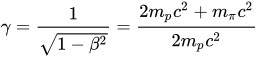
\gamma ={\frac  {1}{{\sqrt  {1-\beta ^{2}}}}}={\frac  {2m_{p}c^{2}+m_{\pi }c^{2}}{2m_{p}c^{2}}}

By assuming that the outgoing particles have no KE in the ZMF, we have effectively considered an inelastic collision in which the product particles move with a combined momentum equal to that of the incoming proton in the Lab Frame.

Our c^{2} terms in our expression will cancel, leaving us with:

{\displaystyle \beta ^{2}=1-\left({\frac {2m_{p}}{2m_{p}+m_{\pi }}}\right)^{2}\approx 0.130}

{\displaystyle \beta \approx 0.360}

Using relativistic velocity additions:
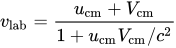
{\displaystyle v_{\text{lab}}={\frac {u_{\text{cm}}+V_{\text{cm}}}{1+u_{\text{cm}}V_{\text{cm}}/c^{2}}}}

We know that {\displaystyle V_{cm}} is equal to the speed of one proton as viewed in the ZMF, so we can re-write with {\displaystyle u_{cm}=V_{cm}}:

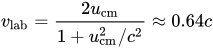
{\displaystyle v_{\text{lab}}={\frac {2u_{\text{cm}}}{1+u_{\text{cm}}^{2}/c^{2}}}\approx 0.64c}

So the energy of the proton must be E=\gamma m_{p}c^{2}={\frac  {m_{p}c^{2}}{{\sqrt  {1-(v_{{\text{lab}}}/c)^{2}}}}}=1221\, MeV.

Therefore, the minimum kinetic energy for the proton must be {\displaystyle T=E-{m_{p}c^{2}}\approx 280} MeV.

A more general exampleEdit

Consider the case where a particle 1 with lab energy E_{1} (momentum p_{1}) and mass m_{1} impinges on a target particle 2 at rest in the lab, i.e. with lab energy and mass E_{2}=m_{2}. The threshold energy E_{{1,{\text{thr}}}} to produce three particles of masses m_{a}m_bm_{c}, i.e.

1+2\to a+b+c,

is then found by assuming that these three particles are at rest in the center of mass frame (symbols with hat indicate quantities in the center of mass frame):

E_{{\text{cm}}}=m_{a}c^{2}+m_{b}c^{2}+m_{c}c^{2}={\hat  {E}}_{1}+{\hat  {E}}_{2}=\gamma (E_{1}-\beta p_{1}c)+\gamma m_{2}c^{2}

Here E_{{\text{cm}}} is the total energy available in the center of mass frame.

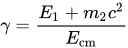
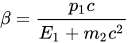
Using \gamma ={\frac  {E_{1}+m_{2}c^{2}}{E_{{\text{cm}}}}}\beta ={\frac  {p_{1}c}{E_{1}+m_{2}c^{2}}} and p_{1}^{2}c^{2}=E_{1}^{2}-m_{1}^{2}c^{4} one derives that

{\displaystyle E_{1,{\text{thr}}}={\frac {(m_{a}c^{2}+m_{b}c^{2}+m_{c}c^{2})^{2}-(m_{1}c^{2})^{2}-(m_{2}c^{2})^{2}}{2m_{2}c^{2}}}} [1]


This article uses material from the Wikipedia article
 Metasyntactic variable, which is released under the 
Creative Commons
Attribution-ShareAlike 3.0 Unported License
.

This article uses material from the Wikipedia article
 Metasyntactic variable, which is released under the 
Creative Commons
Attribution-ShareAlike 3.0 Unported License
.