The Hartree energy is approximately the electric potential energy of the hydrogen atom in its ground state and, by the virial theorem, approximately twice its ionization energy; the relationships are not exact because of the finite mass of the nucleus of the hydrogen atom and relativistic corrections.
The Hartree is usually used like a unit of energy in atomic physics and computational chemistry: for experimental measurements at the atomic scale, the electronvolt (eV) or the reciprocal centimetre (cm−1) are much more widely used.
Other relationships

- = 2 Ry
- ≜ 27.211386245988(53) eV
- ≜ 4.3597447222071(85)×10−18 J
- ≜ 4.3597447222071(85)×10−11 erg
- ≜ 2625.4996394799(50) kJ/mol
- ≜ 627.5094740631(12) kcal/mol
- ≜ 219474.63136320(43) cm−1
- ≜ 6579.683920502(13) THz
- ≜ 315775.02480407(61) K
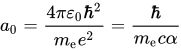
where:
- ħ is the reduced Planck constant,
- me is the electron rest mass,
- e is the elementary charge,
- a0 is the Bohr radius,
- ε0 is the electric constant,
- c is the speed of light in vacuum, and
- α is the fine structure constant.
Note that since the Bohr radius 


| This article uses material from the Wikipedia article Metasyntactic variable, which is released under the Creative Commons Attribution-ShareAlike 3.0 Unported License. |